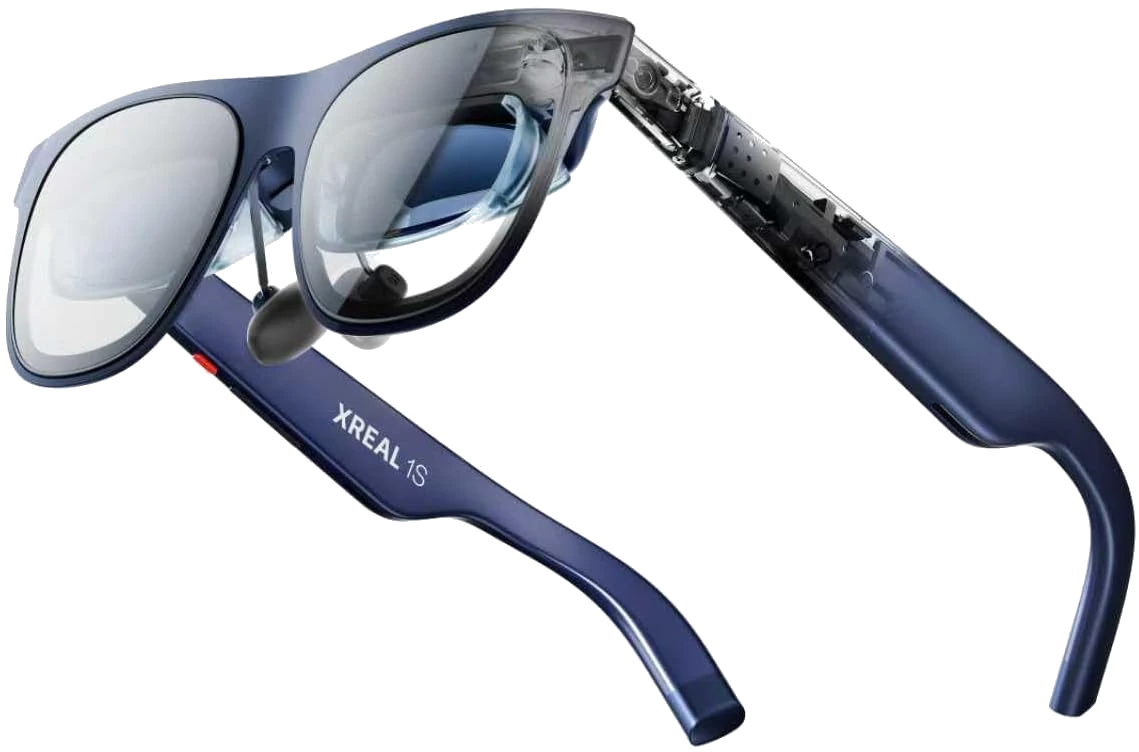
Picture opening your laptop on a cramped flight and, instead of squinting at a 13-inch panel, looking up at what feels like a 500-inch screen floating a few feet in front of you. That's the pitch behind the XREAL 1S, a pair of AR glasses that plug into a phone, laptop, or handheld and turn any of them into a private big-screen setup. At $449, though, the real question isn't whether the trick works. It's whether it works well enough to justify the price for someone who isn't a gadget obsessive.
What Is the XREAL 1S?
The XREAL 1S is a pair of tethered AR glasses that act as an external display. You connect them over a single USB-C cable to any device that supports DisplayPort output, which covers most modern laptops, recent iPhones, Android phones, and gaming handhelds like the Steam Deck and ROG Ally. The glasses then project a large virtual screen in front of your eyes using two Micro-OLED panels.
Each eye gets a 1920x1200 image, and XREAL rates the combined effect as a 500-inch screen seen from across a room. The field of view is 52 degrees, brightness reaches 700 nits, and the whole thing runs on XREAL's own X1 chip, which handles the 3DoF head tracking that can pin the screen in place as you turn your head. Audio comes from open-ear speakers tuned with Bose. It weighs about 82 grams, roughly the same as a chunky pair of sunglasses, and it carries no battery. All the power and the picture come from whatever you plug it into.
Who Should Buy the XREAL 1S?
This is a device for people who already know they want a screen they can carry anywhere. Frequent travelers get the clearest win: a private cinema on a plane or in a hotel room, with none of the neck strain of hunching over a tablet.
Handheld gamers are the other natural fit. Pair the 1S with a Steam Deck or ROG Ally and you get a giant floating display without packing a portable monitor, and the low latency keeps fast games feeling responsive. Remote workers who want a second screen in a coffee shop or on a train can mirror or extend their laptop and keep their work off nearby strangers' eyes.

Who should pass? Anyone hoping for true augmented reality with objects anchored in the room. The 1S is a virtual screen, not a spatial computer. And if you spend your day at a fixed desk, a normal monitor will be sharper, cheaper, and easier on your eyes.
The Features That Actually Matter
- A genuinely big, bright picture. The 700-nit Micro-OLED panels stay watchable even with some ambient light leaking in, and reviewers describe the 500-inch effect as convincing for movies and games. That brightness bump over the older XREAL One is the headline upgrade.
- Plug-and-play with almost anything. Because the 1S rides on standard USB-C DisplayPort, there's no app to install and no account to make. Plug into a compatible phone, laptop, or handheld and the screen appears. Professional reviewers confirm the setup takes seconds.
- Head tracking that holds the screen still. The X1 chip's 3DoF tracking lets you anchor the virtual display so it stays put when you glance away, which makes long viewing sessions far less nauseating than a screen glued to your face.
- Audio you can actually use. The Bose-tuned open-ear speakers won't replace real headphones, but owners consistently report they're clear enough for a movie or a game without earbuds, and you can still hear a flight announcement over them.
What You'll Pay
At $449, the 1S sits in the middle of the AR-glasses market. It costs less than XREAL's own flagship One Pro while keeping most of what makes that model good, and it undercuts several rivals that ask $500 or more. You're paying for the brighter panels, the X1 tracking chip, and the Bose audio, none of which show up on the cheaper media-only glasses that flood Amazon. Keep in mind the sticker isn't always the final bill: if you wear glasses, XREAL's prescription lens inserts cost extra. The price widget above this article shows where today's number sits against our tracked history, so you can tell at a glance whether $449 is the going rate or a moment to wait for a dip.
XREAL 1S vs. the One Pro and a Real Monitor
The XREAL One Pro is the step-up choice. It offers a slightly wider field of view and more advanced optics, so if you want the sharpest, most immersive version XREAL makes and the extra $50 doesn't bother you, it's the better buy. Most people won't notice the difference in daily use.

The Viture Luma Pro is the closest direct rival, with its own bright, wide virtual screen and a built-in myopia dial that skips the need for prescription inserts. If you wear glasses and don't want to buy extra lenses, it deserves a look.
And if you're honest about mostly using a second screen at a desk, skip AR entirely. A standard monitor like the one in our BenQ GW2486TC review gives you a sharper, larger-feeling image for less money, with zero eye fatigue. The 1S earns its keep only when portability is the whole point.
One Thing to Consider Before Buying
The biggest catch isn't the glasses, it's the tether. The 1S has no battery, so it pulls power from whatever you plug it into. Watch a two-hour movie off your phone and you'll watch your phone's battery fall right alongside it. On a handheld, that shortens an already limited play session.
There's a sharpness ceiling too. That 1920x1200-per-eye resolution looks great for video and games, but owners and professional reviewers agree that small text at 100 percent scaling gets tiring to read. Bumping Windows scaling to 125 or 150 percent helps, yet hours of spreadsheet-and-email work is not this screen's strength. Some reviewers also note mild heat near the top of the frame during the 3D-conversion mode, though it stays away from your skin.
Frequently Asked Questions
Q: Do the XREAL 1S glasses work with an iPhone? Yes, with recent models. The iPhone 16 and 17 support USB-C DisplayPort output, so you can plug the 1S straight in. Older iPhones with Lightning ports need an adapter and may not pass video reliably, so check your model first.

Q: Can you use the XREAL 1S with a Steam Deck or ROG Ally? Yes. Both handhelds output video over USB-C, and XREAL specifically markets the 1S for this use. You get a large floating screen with low enough latency that fast games still feel responsive, which is one of the strongest reasons to buy.
Q: Is the XREAL 1S worth it over the XREAL One? For most buyers, yes. The 1S adds brighter panels and higher resolution while often costing less than the older One, which makes it the better value in XREAL's current lineup. The One Pro stays the pick only if you want the widest field of view.
The Verdict
The XREAL 1S is the AR glasses to beat in 2026: bright, comfortable, and refreshingly simple to use, with a big-screen effect that genuinely impresses on a plane or a handheld. Buy it if portability is the point, wait for a price dip if you're only curious, and skip it if what you really need is a desk monitor.
Check the price card above before you commit. If $449 is sitting at or below where we've tracked it, and a screen you can fold into a jacket pocket solves a real problem for you, the 1S is an easy recommendation.