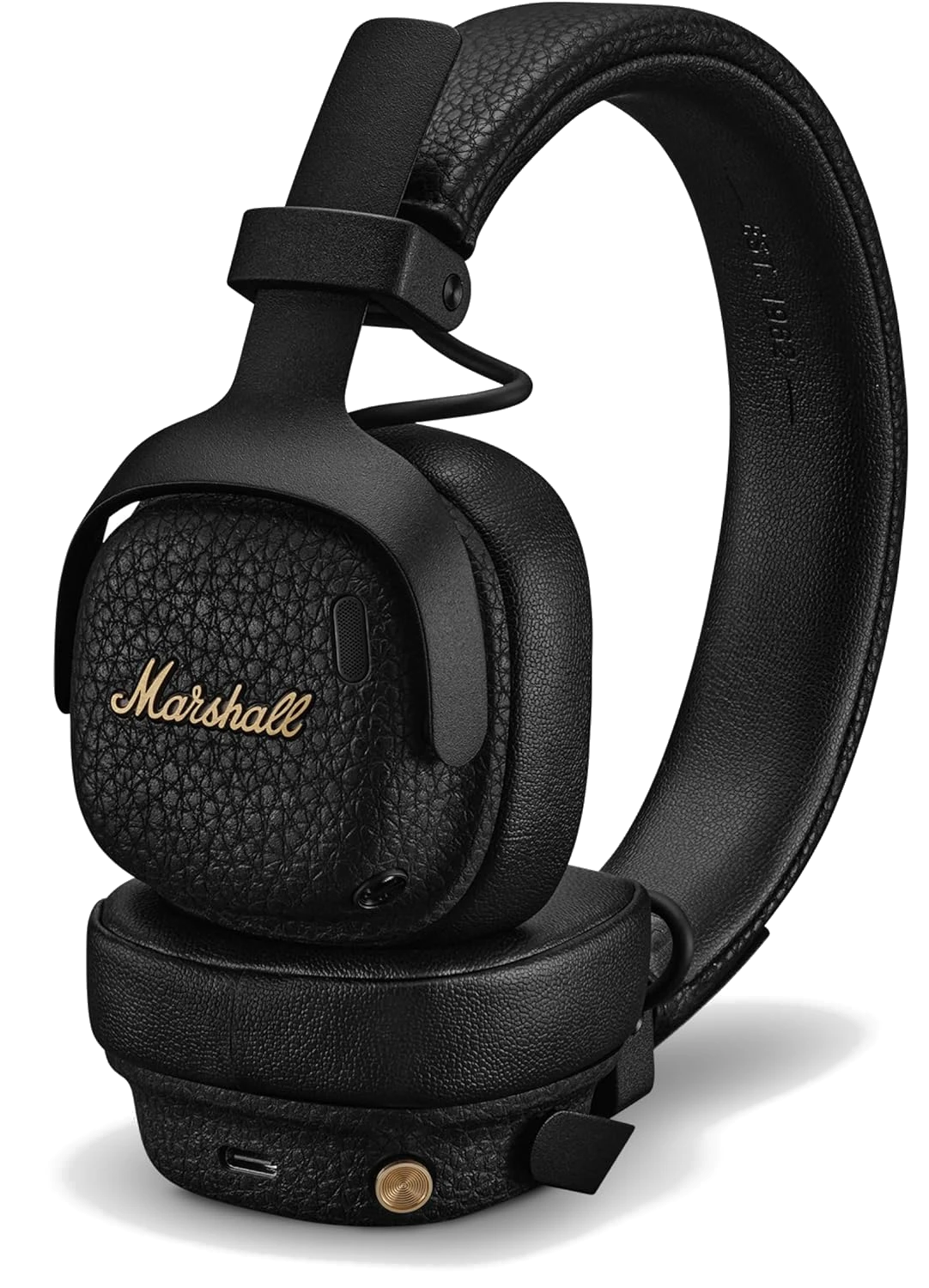
On-ear headphones almost went extinct. Walk the headphone wall at any store in 2026 and it's a sea of over-ear cans and tiny earbuds, with the compact pads that rest on your ears nowhere to be found. Marshall clearly didn't get the memo. The Milton ANC is a $229 on-ear pair with adaptive noise cancelling, 50 hours of battery with that ANC switched on, and a battery you can actually replace when it wears out. That last detail alone earns it a spot on your shortlist.
What Is the Marshall Milton ANC?
The Milton ANC is Marshall's first on-ear headphone to include adaptive active noise cancellation. It pairs 32mm drivers with a claimed 20Hz to 40kHz frequency range, runs on Bluetooth 6.0, and supports the SBC, AAC, LC3, and LDAC codecs, so Android owners can stream higher-resolution audio without a cable. Each cup rests on your ear rather than swallowing it, and the whole thing weighs about 200 grams and folds up for travel.
Marshall launched it in May 2026 at $229 with the brand's usual guitar-amp styling: a textured black finish, gold accents, and a single control knob you use to handle playback, volume, and calls. A companion app adds an EQ, a Soundstage spatial-audio mode with adjustable room size, transparency mode, and adaptive loudness that nudges the tuning as your volume changes. On paper, it's a feature set usually reserved for headphones that cost more and sit fully over your ears.
Who Should Buy the Marshall Milton ANC?
This one has a clear audience. If you wear glasses, on-ear pads sit lighter against the temple arms than the tight clamp of many over-ear cans, and reviewers repeatedly call these out as unusually comfortable for the format. If you have a smaller head that gets swallowed by big over-ear cups, the fit lands better here too.

It also suits the traveler who hates recharging. At 50 hours with ANC on, you could fly round-trip across the country several times before hunting for a charger. And because the battery is user-replaceable, this is a rare set of wireless headphones you might still be using in five years rather than tossing when the cell degrades. Skip it if you're a bass-first listener chasing rumble, or if you live on phone calls all day. More on that below.
What the Specs Actually Get You
- 50 hours with ANC on, 80 with it off. That's not a typo. Most flagship over-ears top out near 30 hours with noise cancelling active, so the Milton roughly doubles the runway between charges.
- A replaceable battery. When the cell eventually fades, you swap it instead of landfilling the headphones. Almost nothing else in this price band offers that.
- 200 grams and foldable. Light enough to wear through a long workday, and the hinges collapse the cups down for a bag or a jacket pocket.
- LDAC over Bluetooth 6.0. On a compatible Android phone, LDAC carries more detail than the standard SBC most cheap headphones default to, so higher-quality files actually sound higher quality.
- App EQ, Soundstage, and adaptive loudness. The default tuning leans bright, but the in-app EQ lets you tame the treble and lift the mids to taste, and Soundstage widens the presentation for movies.
What You'll Pay
At $229, the Milton ANC sits in the awkward middle of the headphone market: pricier than the $99 to $150 crowd, but a solid chunk cheaper than the $329 to $400 flagship over-ears from Sony, Bose, and Sennheiser. You're paying for the battery life, the replaceable cell, and Marshall's build and styling rather than class-leading noise cancelling. The live price and its tracked history render in the widget above this article, so you can see where today's number sits against where it's been before you commit.
The Marshall Milton ANC vs. the Alternatives
If you want the same kind of quiet in something that disappears into a pocket, our Nothing Ear (3) review covers a set of earbuds that costs far less and travels lighter, at the expense of the Milton's marathon battery and over-the-head comfort. Earbuds also can't be shared around a desk the way a pair of headphones can.

If noise cancelling is the whole point of the purchase, the Sony WH-1000XM6 is the safer buy. It's an over-ear design with a full seal around the ear, which clamps down on airplane and office noise more completely than any on-ear pad can. You'll pay more and lose the replaceable battery, but for a heavy commuter that trade often makes sense.
One Thing to Consider
Two, honestly. First, call quality is the Milton's clear weak point. Reviewers describe the microphone as scratchy and not true to life, with call recipients noting the caller sounded worse than on other headphones. If half your day is on Zoom or the phone, that matters. Second, the noise cancelling is merely good, not great: because on-ear pads don't fully seal around the ear, professional reviewers found the ANC struggles with low rumble and lets some sharper sounds leak through. The stock tuning also runs bright enough to edge toward sibilance on harsh recordings, though the app EQ pulls it back. None of these are dealbreakers for the right buyer, but you should know them before paying.
FAQ
Q: Is the Marshall Milton ANC good for phone calls? It's the weakest part of the package. Reviewers consistently flag the microphone as scratchy, and people on the other end of the call reported the caller sounded muffled compared to rival headphones. For occasional calls it's fine; for all-day conferencing, look at an over-ear set with a better boom-free mic array.

Q: How long does the Marshall Milton ANC battery last? Marshall rates it at 80 hours with noise cancelling off and 50 hours with ANC on. Those are unusually high numbers for the category, roughly double what many flagship over-ears manage. A quick charge also delivers several hours of playback from a short top-up.
Q: Are on-ear headphones like the Milton ANC comfortable with glasses? That's actually one of their strengths. On-ear pads press against the outer ear rather than clamping a seal around it, which puts less pressure on the arms of your glasses. Reviewers repeatedly single out the Milton as one of the comfier on-ear pairs for glasses wearers, though comfort with any on-ear design still comes down to your own ears over long sessions.
The Verdict
The Marshall Milton ANC is the best argument in years for buying on-ear headphones, thanks to a genuinely huge battery, a replaceable cell, and a light, foldable build that flatters glasses wearers. Buy it if that profile is you; wait for the over-ear crowd if class-leading ANC or call quality tops your list.
If the price in the card above sits at or near its usual $229, and you've been eyeing a lighter, longer-lasting alternative to the big over-ear cans, this is an easy pair to say yes to.